
What Goes Under Landscape Lighting: Base Materials and Winter Stability in Winnipeg
- Ditchfield Soils

- Dec 26, 2025
- 5 min read
When landscape lights tilt or fail after their first Winnipeg winter, homeowners blame the fixture and shop for "better quality." Yet the fixture typically performs exactly as designed, the failure happens underneath, where improper base materials, inadequate drainage, or shallow installation create conditions no fixture can overcome.
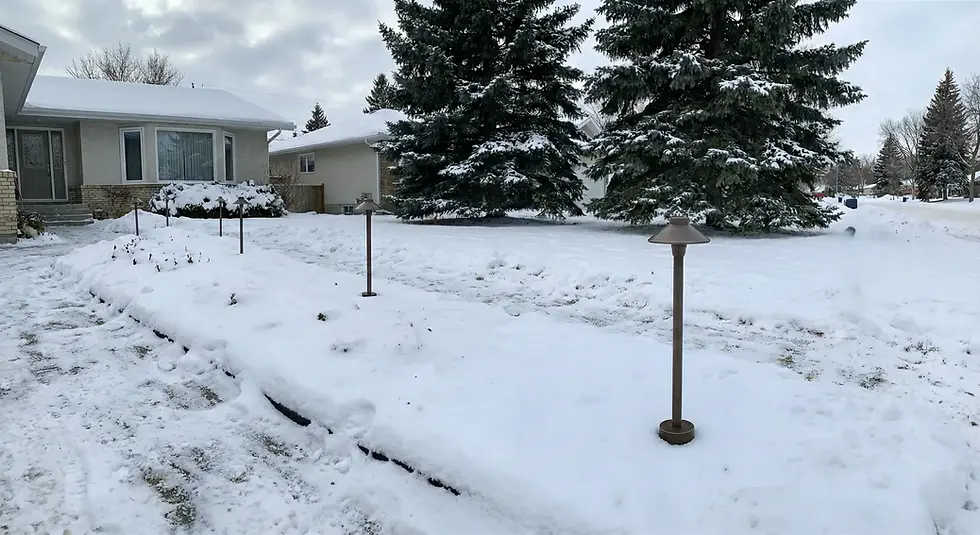
University of Manitoba research shows frost heave causes 64% of premature landscape infrastructure failures in Manitoba. Landscape lighting, with shallow wiring and ground-mounted components, proves particularly vulnerable.
Why Lighting Fails in Winter (Usually Not the Fixture)
Frost heaves displace fixtures and wiring. When groundwater freezes, it expands, creating upward pressure that lifts everything in its path. By spring, level fixtures lean at 15 degrees, wiring pulled taut, connections stressed.
National Research Council Canada documents that Winnipeg's frost depth regularly reaches 1.8-2.4 meters, among the deepest in populated Canada. Landscape lighting typically installed at 15-30 cm depth, well within the active frost zone.
Poor drainage creates ice pockets. Water pooling around fixture bases freezes into expanding ice masses that exceed fixture mounting strength. Manitoba Infrastructure research shows proper drainage reduces winter damage by 78%.
Inadequate base materials allow settling. Organic soil compresses during freeze-thaw cycles. Fixtures mounted in plain soil settle unevenly, creating tilting that accelerates drainage problems and frost effects.
Base Material Options
Limestone Screenings (Optimal Choice)
Limestone screenings, finely crushed limestone from dust to ¼-inch particles, provide ideal bases for Winnipeg landscape lighting. The material compacts firmly when tamped, creating stable support resisting frost heave.
Key advantages:
Excellent drainage prevents water accumulation
Compacts firmly providing rigid support
Contains fines that lock together preventing shifting
Alkaline chemistry won't corrode electrical components
Professional installations use 4-6 inches of compacted limestone screening as a base layer. This creates drainage while providing stable mounting. Canadian Construction Materials Centre testing shows that properly compacted screenings provide 95% of standard proctor density, far superior to uncompacted soil.
Washed Gravel (Secondary Option)
Clean washed gravel (¾-inch to 1-inch) offers excellent drainage but less stability than screenings. Larger particle size improves drainage but reduces compaction and load-bearing.
Best for: Drainage layers beneath screenings, areas requiring maximum drainage, temporary installations
Limitations: Large voids allow settling, require deeper installation, more expensive, can shift during freeze-thaw
Professional installations often use 2-3 inches washed gravel beneath limestone screenings, combining drainage capacity with stability.
Sand (What NOT to Use)
Sand performs poorly in freeze-thaw climates:
Moisture retention: Capillary action keeps fixture bases persistently moist, promoting ice formation
Poor compaction: Quickly loosen with vibration or moisture changes
Frost susceptibility: Holds moisture while providing minimal heave resistance
University of Alaska Fairbanks research found sand bases experienced 3-4 times more frost heave than gravel or screening bases.
Drainage: Why Water Is the Enemy
Water's Destructive Behaviour
Water expands 9% when freezing, generating enormous, confined forces that crack concrete, bend metal hardware, and snap conduit. The problem intensifies with Winnipeg's 8-12 freeze-thaw cycles between November and March. Each cycle means water melts, pools at fixture bases, then refreezes.
Proper Drainage Design
Create pathways away from fixtures: Ground around lights should slope away at a minimum 2% grade (2 cm drop per meter). This provides sufficient gravity flow, preventing pounding.
Use drainage layers beneath: Excavate 8-12 inches deep, fill the bottom 4-6 inches with washed gravel, top with 2-4 inches of compacted limestone screening. This intercepts water before reaching fixture bases.
Ensure surface water shed: Mulch, soil, and ground cover should direct water away, not trap moisture. Many homeowners inadvertently create moisture traps by piling mulch around fixtures.
Consider seasonal sources: Spring melt creates temporary flows as snow melts. Ensure drainage accommodates these surges, not just rainfall.
The Canadian Mortgage and Housing Corporation recommends outdoor structure drainage exceeding expected water volumes by 50% to account for spring melt and heavy rain.
Frost Heave and Material Strategies
Understanding Frost Heave
Frost heavily occurs when soil water freezes, expands, and pushes everything upward. Cold Regions Research and Engineering Laboratory documents uplift pressures exceeding 100 kPa (2,000 pounds per square foot). Landscape fixtures cannot resist these forces without proper base preparation.
Minimizing Heave
Coarse base materials: Limestone screenings and gravel contain minimal fines (particles under 0.075mm). Frost heaves correlate strongly with fine particle content. Replacing native soil with coarse materials eliminates heave-promoting conditions.
Enhanced drainage: Removing water from the frost zone eliminates frost heave requirements. Properly drained bases remain relatively dry, preventing ice lens formation.
Deeper installation: While rarely below full frost depth, installing to 60-75 cm significantly reduces heave. Most movement occurs in the upper 30-45 cm.
Rigid conduction: Use rigid PVC with expansion joints, preventing wire pulling or crimping when soil moves.
Professional Winnipeg installations excavate to 45-60 cm, line with landscape fabric, fill with drainage materials, and cap with limestone screenings. This creates a non-heaving “pillar” isolating fixture from the surrounding soil.
DIY vs Professional Installation
Common DIY Errors
Inadequate depth: Most DIY digs just deep enough for fixture stakes (15-20 cm), leaving everything in the active frost zone with no drainage benefit.
Using existing soil: Compacting native soil without drainage materials saves initial cost but guarantees frost damage.
Poor compaction: Screenings must be compacted in 2-inch layers with proper tamping. Simply pouring into holes causes settling.
Inadequate drainage: Focusing on fixture location without considering water pathways.
Mixing materials incorrectly: Mixing sand with gravel reduces drainage and creates frost-susceptible combinations.
When DIY Works
DIY succeeds with proper methods:
Excavate to 45 cm minimum
Use limestone screenings or washed gravel (not sand or native soil)
Slope ground away from fixtures, use drainage layers
Compact in 5 cm layers
Use conduits for all buried wiring
Professional Advantages
License contractors provide:
Site assessment identifying drainage patterns and frost-susceptible areas
Proper equipment (plate compactors, excavation tools)
Bulk material purchasing at competitive costs
Code compliance ensuring safety standards
Warranty protection (most manufacturers require professional installation)
Cost difference: $50-150 per fixture including labor and materials. For 10-15 fixtures, professional installation costs $500-2,250 more than DIY. However, professional work delivers 15–20-year fixture life versus 3-7 years for many DIY installations.
Material Selection by Condition
Standard conditions (well-drained sites):
4-6 inches compacted limestone screenings
Minimum 45 cm fixture depth
2% grade away in all directions
Poor drainage (heavy clay, low areas):
3-4 inches washed gravel base
4-6 inches of limestone screenings above
Consider French drains for severe conditions
High traffic/vehicle areas:
6-8 inches compacted screenings (extra stability)
Rigid conduit protection
Enhanced foundation resisting lateral forces
Steep slopes:
Terraced installation creating level platforms
4-6 inches compact screenings
Retention walls or landscape ties
Attention to surface water flow
Long-Term Maintenance
Annual inspection (spring):
Check fixture levelness
Verify drainage remains clear
Look for settling or tilting
Test the electrical function
5-Year maintenance:
Temporarily remove fixtures
Refresh screenings, adding material as needed
Re-compact bases
Verify drainage pathways
10-Year overhaul:
Complete base excavation and replacement
Wiring inspection and possible replacement
Fixture evaluation and upgrade
This schedule prevents gradual degradation. Five-year refresh costs $20-40 per fixture, far less than premature replacement.
Quality Materials Matter
For DIY or contractors, Ditchfield Soils provides landscape materials suited to Winnipeg's climate. Our limestone screenings are properly graded for compaction and drainage.
Quality-based materials cost marginally more than bulk fill but deliver dramatically better performance. For typical installations requiring 0.1 cubic meters of screenings, the cost difference between economy and premium materials is $5-8 per fixture, negligible compared to performance improvement.
Professional installation from Lawn 'N' Order includes proper base preparation as standard practice, delivering lighting systems functioning reliably for decades.
Related Resources:
National Research Council Canada: Frost Heave Research


Comments