
The Science of Frost Heave: Why Gravel Size Matters in Winnipeg
- Ditchfield Soils

- Dec 12, 2025
- 3 min read
Understanding Frost Heave: The $1 Billion Problem
Frost heave contributes to billions in annual infrastructure damage across Canada, with cold weather events alone causing over $3 billion in insured losses in recent years (Insurance Bureau of Canada). Winnipeg faces particularly severe conditions with frost penetration reaching 1.5-1.8 meters deep and approximately 60 freeze-thaw cycles annually per Environment Canada data.
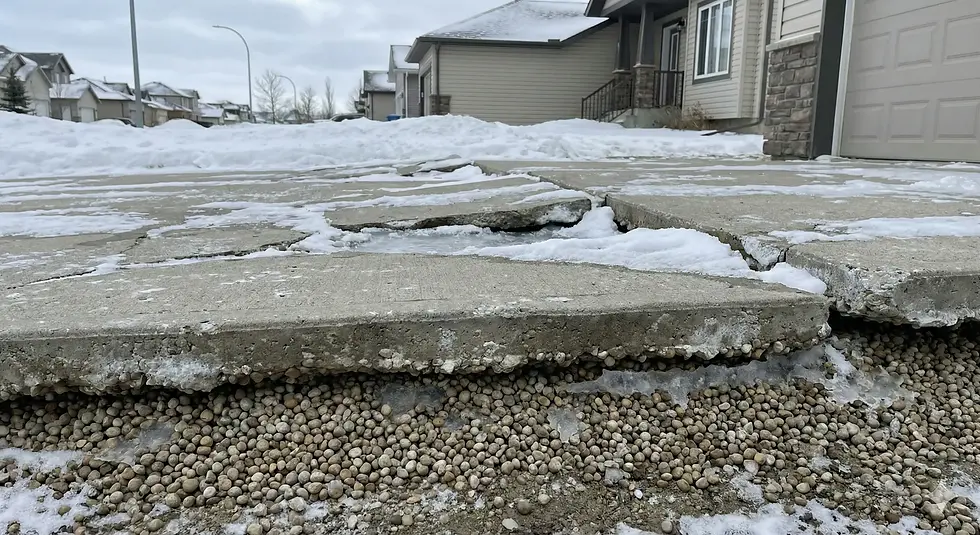
The frost heave mechanism: Water migrates through soil toward the freezing front via capillary action, forms expanding ice lenses, and generates upward pressure exceeding 30,000-50,000 PSF, enough force to crack foundations and destroy pavement. The key to prevention? Proper base material selection that blocks this destructive cycle.
Why Pea Gravel Fails Under Freeze-Thaw
Uniform Size = Perfect Capillary Pathways
Pea gravel's uniform 1/4 to 3/8 inch particles create consistent void spaces that act as efficient water highways. Research from the Cold Regions Research and Engineering Laboratory shows uniform aggregates facilitate capillary water rise of 30-50 cm or more, readily feeding ice lens formation throughout Winnipeg's frost zone.
Rounded Stones Can't Interlock
Smooth, rounded particles roll past each other under pressure rather than locking together. University of Manitoba research indicates rounded aggregates show 40-60% less shear strength than angular materials, making pea gravel bases vulnerable to frost heave uplift and displacement.
Real-world Result
Industry experience shows pea gravel bases frequently fail within 5-10 years in Manitoba's frost conditions, often requiring costly reconstruction.
Why 3/4 Inch Crusher Run Prevents Heave
Varied Gradation Blocks Water Movement
Crusher run (¾ down, road base) combines ¾ inch stones with graduated smaller particles down to dust-sized fines. This varied gradation disrupts capillary pathways, large stones create framework, medium stones fill voids, and fine particles block remaining spaces.
Transportation Association of Canada research shows well-graded crusher run significantly disrupts capillary flow compared to uniform aggregates.
Angular Particles Lock Together
Crushed stone's sharp edges create mechanical interlock under compaction. When properly compacted to 95%+ density, angular particles wedge together creating a stable matrix that:
Resists 30,000+ PSF uplift forces
Distributes loads uniformly
Maintains structure through repeated freeze-thaw cycles
Provides 30+ year performance in Manitoba conditions
Browse our crusher run and base materials for frost-resistant options.
Angular vs. Rounded: Why Shape Matters Most
Particle shape trumps size alone. Uniform large rounded stones (1–2-inch river rock) perform worse than properly graded angular materials with smaller maximum sizes (¾ inch crusher run).
Performance differences include:
Property | Angular Materials | Rounded Materials |
Shear strength | 40-60% stronger | Lower |
Compaction density | 95-98% | 85-92% |
Freeze-thaw cycles | 50+ | 10-20 |
The critical insight: The common belief that "bigger stones = better stability" is wrong. Proper gradation + angular shape + adequate compaction create frost heave resistance.
How Proper Gravel Stops Frost Heave
Well-graded crushed stone interrupts the damage cycle by:
Blocking water migration, tortuous pathways reduce water movement 80-90%
Distributing forces uniformly interlocked structure prevents localized heaving
Maintaining stability, angular interlock resists degradation through repeated cycles
Draining rapidly large voids allow quick thaw drainage preventing settlement
The result: Minimal movement instead of destructive heaving.
Material Selection Guide
Application | Recommended Material | Base Depth | Compaction |
Driveways | ¾" crusher run | 8-10 inches | 95%+ |
Patios/walkways | Crusher run | 6-8 inches | - |
Foundation drainage | ¾-1½" clear stone | 12+ inches | - |
View complete gravel selection for frost-resistant applications.
Never Use for Structural Bases
❌ Pea gravel (uniform, rounded, high heave risk)
❌ River rock (rounded, poor interlock)
❌ Any uniform-sized aggregate (facilitates water rise)
❌ Sandy materials alone (frost-susceptible)
These may work decoratively but lack structural characteristics preventing frost heave.
Installation Essentials
Proper depth: 6-10 inches depending on application
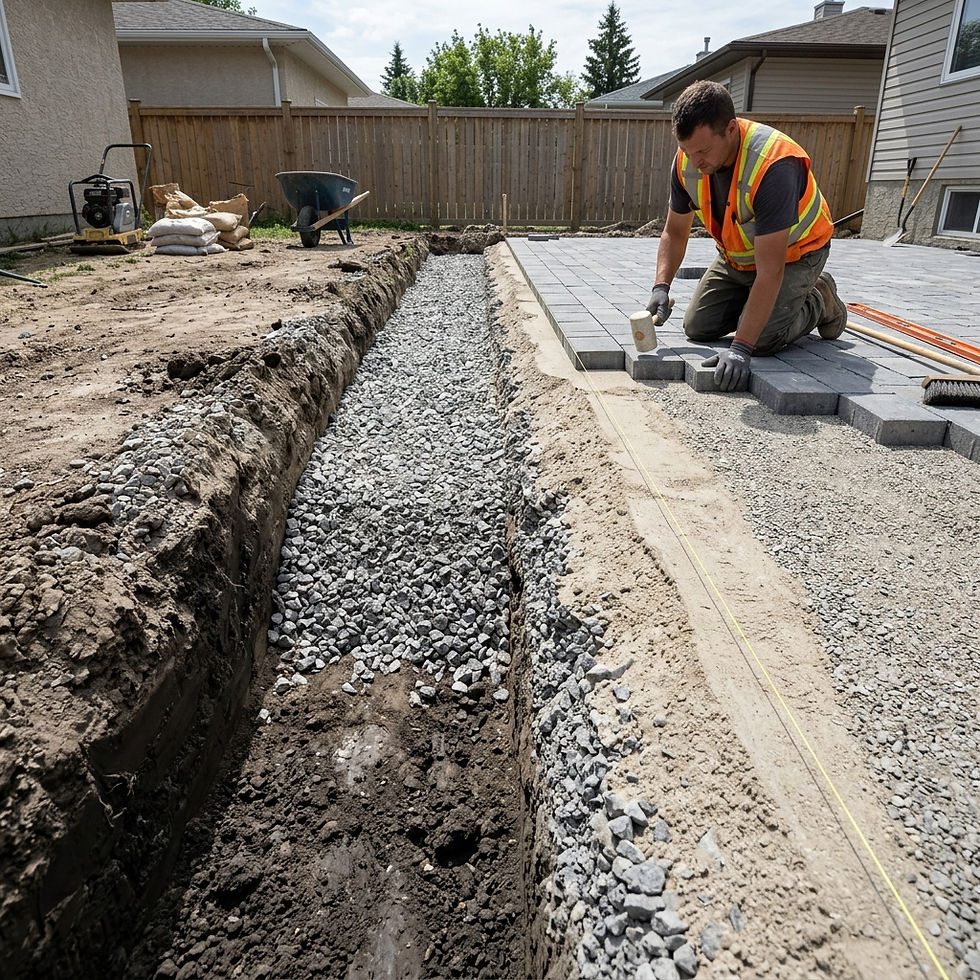
Compact in lifts: 3–4-inch layers, compact each separately
Moisture control: Optimize compaction with 6-9% moisture content
Good subgrade: Remove organics, address soft spots, ensure drainage
Cost reality: Quality crusher run costs 30-50% more than pea gravel. But consider: $300-500 premium for proper materials versus $3,000-8,000 for tear-out and reconstruction when inferior bases fail.
Protect Your Investment with Material Science
Understanding frost heave physics enables smart decisions protecting hardscaping through Winnipeg's demanding conditions. The difference between decades of performance and premature failure traces directly to base material selection, choices made before surface materials ever appear.
Planning projects or addressing frost heave problems? Contact Ditchfield Soils for expert guidance on material selection and specifications. Our experience with Winnipeg's frost conditions ensures your projects deliver lasting performance.
Choose materials based on science, not just cost. Your investment deserves proper foundation.


Comments